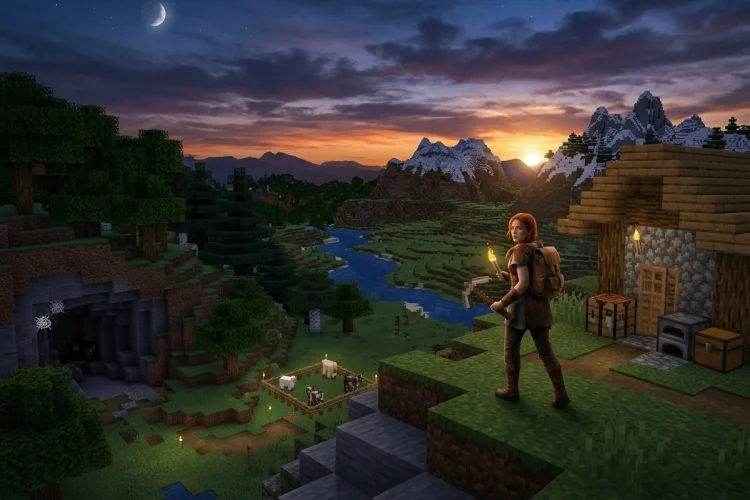
Minecraft can look incredibly simple at first. Everything is made of blocks, there are no complicated opening cutscenes, and the game does not hand you a long list of missions.
Then the sun begins to set, strange noises come from a nearby cave, and you realize you have no house, food, weapons, or idea what to do next.
That freedom is exactly what makes Minecraft special. You can build a peaceful farm, explore underground caves, fight monsters, create complicated machines, or spend hours designing a house that serves no practical purpose beyond looking cool.
However, the lack of a fixed path can also make the first few hours confusing. This Minecraft beginner’s guide explains the essential mechanics, from selecting an edition and surviving your first night to crafting equipment, exploring safely, and playing with friends.
You do not need to memorize every recipe or understand advanced redstone systems immediately. Start with the basics, experiment often, and let each new world teach you something different.
What Is Minecraft and How Does It Work?
Minecraft is an open-world sandbox game built around blocks, creatures, exploration, and player creativity. Instead of following one mandatory storyline, you decide what kind of adventure you want to have.
You might build a castle, search for diamonds, fight hostile mobs, explore another dimension, or simply create a comfortable village. Every new world is generated from a seed, which determines its landscapes and structures.
You can encounter forests, plains, deserts, oceans, mountains, caves, villages, and many other environments known as biomes. Each area offers different resources, animals, dangers, and building possibilities.
Minecraft does have long-term challenges, including visiting dangerous dimensions and defeating powerful enemies. Still, you are never forced to complete them. A successful Minecraft world is simply one that you enjoy playing.
Java Edition vs. Bedrock Edition
Before beginning, you should understand which version of Minecraft you are playing. The two main versions are Java Edition and Bedrock Edition.
Java Edition is primarily designed for Windows, macOS, and Linux computers. It is especially popular among players who enjoy community servers, custom maps, technical gameplay, and third-party modifications.
Bedrock Edition is available across Windows PCs, consoles, and mobile devices. Its biggest advantage is cross-platform multiplayer, allowing people on supported devices to play together more easily.
Bedrock also provides access to the Minecraft Marketplace, where players can find officially distributed worlds, texture packs, skins, and add-ons.
Neither version is automatically better for everyone. Java is often preferred for extensive customization, while Bedrock is convenient for cross-play and playing on different devices. Choose the edition that matches your platform and the people you want to join.
Choose the Right Game Mode
1. Survival Mode
Survival is the classic Minecraft experience. You begin with an empty inventory and must gather materials, craft tools, manage hunger, protect your health, and survive attacks from hostile creatures.
Every block you use must normally be collected first. Building a large house therefore requires planning, exploration, and plenty of mining. This makes even a simple base feel rewarding because you earned every material yourself.
2. Creative Mode
Creative Mode gives you immediate access to blocks and items without requiring you to gather resources. You can fly, build freely, and focus on experimentation without worrying about hunger or most dangers.
This mode is ideal for learning controls, testing building ideas, or creating large projects. New players can also use Creative Mode to become familiar with different blocks before starting a serious Survival world.
Other modes exist, but Survival and Creative are the best starting points. Choose Survival for adventure and progression or Creative for unrestricted building.
How to Survive Your First Day
Your first day in Survival Mode is a race against sunset. Hostile mobs begin appearing in dark areas at night, so your immediate priorities should be wood, tools, food, light, and shelter.
Begin by punching a tree until you collect several logs. Turn the logs into wooden planks, use four planks to create a crafting table, and make sticks for your first tools. A wooden pickaxe lets you collect stone, which can quickly be turned into stronger stone equipment.
Next, gather food from animals or nearby crops. Look for sheep because three pieces of wool and three wooden planks can be used to make a bed. Sleeping in a bed skips the dangerous night and creates a new respawn point.
Do not spend your entire first day searching for the perfect location. A tiny wooden house, a dirt hut, or even a sealed room inside a hillside is enough. Add a door and place torches inside so hostile mobs cannot appear in your shelter.
Learn the Basics of Crafting
Crafting transforms basic resources into useful items. Your personal inventory contains a small crafting grid for simple recipes, while a crafting table provides a larger grid and access to many more possibilities. Every recipe requires the correct materials and arrangement.
Your early progression will usually move from wooden tools to stone, iron, and eventually diamond equipment. You do not need to create every possible tool immediately. A pickaxe, axe, sword, furnace, chest, and several torches are enough for your first expeditions.
The recipe book can show items that you are currently able to make. Use it instead of trying to memorize hundreds of crafting patterns. Over time, common recipes will become familiar naturally.
A furnace is another essential workstation. It can cook raw food and smelt materials such as iron ore into usable ingots. Always carry fuel, such as coal or wooden materials, when working around your base.
Mining Without Getting Lost
Mining is one of Minecraft’s core activities, but digging randomly can quickly become dangerous. Caves may contain valuable resources, yet they can also hide zombies, skeletons, creepers, lava, and deep drops.
Bring enough food, torches, spare pickaxes, and basic weapons before entering a cave. Place torches consistently on one side of your route. When you want to return home, keep those torches on the opposite side as you walk back.
Never dig straight down. You could fall into lava, a large cave, or another dangerous area without time to react. Digging straight upward can also cause sand, gravel, water, or lava to fall onto you.
Store valuable items in a chest before beginning a risky journey. Dying is less frustrating when your diamonds, rare materials, and favorite equipment are safely waiting at home.
Manage Health, Hunger, and Hostile Mobs
In Survival Mode, your health and hunger bars require regular attention. Keeping your hunger level high allows your health to recover under normal conditions, so carry food whenever you leave your base.
Cooked meat restores more hunger than most raw food, but farming offers a dependable long-term supply. Wheat, potatoes, carrots, and other crops can reduce your dependence on hunting. A simple farm near water can produce enough food for regular exploration.
Different hostile mobs require different responses. Zombies are straightforward at close range, while skeletons attack with bows. Spiders move quickly, and creepers can approach quietly before exploding.
You do not have to fight everything you see. Running away, blocking an entrance, using a shield, or sleeping before mobs appear can be smarter than entering an unnecessary battle.
Build a Practical Starter Base
Your first proper base should be useful before it becomes beautiful. Include a bed, crafting table, furnace, storage chests, lighting, and a secure entrance. Building near trees, water, animals, and open land can make early resource gathering easier.
Organize your storage before it becomes chaotic. Separate building blocks, food, tools, ores, and miscellaneous items into different chests. Even basic organization can save a surprising amount of time later.
Mark your base with something visible, such as a tall tower, campfires, or a unique structure. You should also record its coordinates when that information is available. Exploring is much less stressful when you know how to return home.
Once your basic needs are covered, improve the design gradually. Add windows, farms, animal areas, enchanting rooms, or underground storage instead of trying to create a giant mansion on the first day.
Explore and Play With Friends
Exploration is where Minecraft begins to feel enormous. Traveling beyond your starting area can reveal villages, ruined portals, underground structures, unusual biomes, and resources that are unavailable near your base.
Prepare before taking a long trip. Bring food, a bed, building blocks, tools, and a way to remember your route. Avoid carrying every valuable item you own, especially when exploring unfamiliar caves or dimensions.
Minecraft can also be played with friends through local worlds, online servers, or Realms. Bedrock players can join supported cross-platform worlds, while Java players can connect to community servers without needing a Realms subscription.
When playing with others, decide whether resources and buildings are shared. A few simple rules can prevent someone from accidentally emptying the community food chest or turning another player’s house into an unwanted chicken farm.
What Should You Do After the Basics?
Once you have a safe base, reliable food, and iron equipment, set a personal goal. Search for diamonds, build an automatic farm, improve a nearby village, explore the Nether, or create a detailed map of your surroundings.
There is no perfect order. Some players enjoy combat and progression, while others spend hundreds of hours building towns. Minecraft remains interesting because one project usually creates an idea for the next one.
Avoid comparing your first house to enormous creations made by experienced builders. Those projects often require advanced planning and many hours of work. Your small wooden cabin is not a failure – it is the beginning of your world’s history.
Minecraft becomes much easier once you understand its basic rhythm: gather resources, craft useful equipment, create shelter, manage food, and explore carefully.
New players should begin with achievable goals instead of trying to learn every block, creature, recipe, and dimension at once.
Start by surviving one night. Then improve your tools, organize your base, create a dependable food source, and explore a little farther each day. Mistakes are part of the experience, whether you lose your way underground or discover that your wooden roof is dangerously close to lava.
Create a new world, choose a game mode that fits your style, and start experimenting. Your first base may be simple, but every impressive Minecraft adventure begins with someone punching a tree.