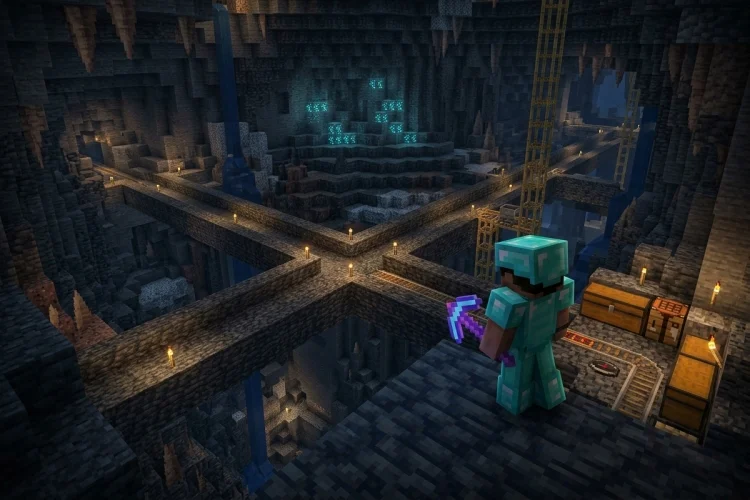
Finding your first diamonds in Minecraft is one of those moments that never gets old. You can spend what feels like forever breaking through deepslate, only to turn a corner and suddenly spot those bright blue pixels hiding in the wall.
The problem is that digging randomly is not a very efficient strategy. Minecraft’s underground world is enormous, and diamond ore follows specific generation rules.
Once you understand the best mining depth, the right tunnel layout, and how to use enchantments, you can greatly improve your chances of finding valuable ore without wasting dozens of pickaxes.
This guide explains how to find diamonds fast in Minecraft using practical methods that work in modern Java and Bedrock worlds.
You will learn the best Y level for diamonds, whether branch mining or cave exploration is more effective, what equipment to bring, and how to turn a small ore vein into a much larger reward.
Where Do Diamonds Generate in Minecraft?
Diamond ore generates in the Overworld below Y level 16. Its frequency increases as you travel deeper, which means the lowest parts of the world generally offer the best chances of finding it.
However, diamond ore also has reduced air exposure. In simple terms, the game deliberately hides much of it behind stone or deepslate instead of placing it openly on cave walls. Diamonds may also generate beside water because underwater blocks are not considered exposed to air.
This mechanic is important because it explains why a huge cave does not always contain dozens of visible diamond veins. Exploring caves exposes many blocks quickly, but controlled tunnel mining can reveal ores that would otherwise remain completely buried.
The amount of diamond ore in the deepest deepslate layers was increased in later updates for both Java and Bedrock Editions. That change made low-level mining more rewarding than it was immediately after the Caves & Cliffs world-generation overhaul.
What Is the Best Y Level for Diamonds?
1. Mine Around Y -58 or Y -59
For modern Minecraft worlds, Y -58 to Y -59 is the most practical range for diamond mining. The official generation rules state that diamonds become more common the lower you go, while the bottom bedrock layer begins around Y -64.
Mining at Y -58 or -59 places you close to the richest diamond levels without forcing you to constantly break through bedrock. It also gives you enough room to create a two-block-high tunnel.
There is no single block that guarantees diamonds. World generation is random, so you may find several veins in a short tunnel or travel hundreds of blocks without seeing one. The recommended depth simply gives you better odds over a long mining session.
2. Check Your Coordinates
In Java Edition, you can usually view your coordinates through the debug screen by pressing F3. Look for the XYZ display and focus on the middle number, which represents your vertical position.
In Bedrock Edition, coordinates can be enabled from the world settings. They normally appear in the upper-left corner of the screen.
When players say they are mining at Y -59, they usually mean the block where their character’s feet are standing. Keep checking the coordinate display while building your staircase downward.
Use Branch Mining for Consistent Results
Branch mining is one of the safest and most reliable ways to locate buried diamond ore. It involves creating one long central tunnel with smaller side tunnels extending from it.
Begin at approximately Y -58 or -59 and dig a two-block-high main corridor. Create side branches every two or three blocks, depending on how much stone you want to expose.
Spacing the tunnels properly is important. If branches are too close together, you will repeatedly reveal blocks that were already visible from another tunnel. If they are too far apart, you may pass close to a diamond vein without exposing it.
A simple design uses side tunnels that extend about 20 to 50 blocks from the central corridor. Place torches or another marker at each entrance so you can quickly see which branches have already been explored.
Branch mining may feel slower than running through a giant cave, but it is controlled and predictable. You encounter fewer hostile mobs, avoid large drops, and expose diamond ore that the reduced-air-exposure system hides inside deepslate.
Explore Deep Caves for Faster Block Exposure
Caving can be faster when you want to inspect a large number of blocks without breaking every one of them. A massive cave near the bottom of the world may reveal diamonds on walls, floors, ceilings, or around underground pools.
The downside is that visible diamonds are less common than fully buried ones. Minecraft’s modern ore system reduces the amount of diamond ore exposed directly to air, so an impressive cave can sometimes look surprisingly empty.
Still, deep cave exploration is worth trying because it also provides redstone, gold, lapis lazuli, and other useful materials. Look carefully around water and lava because diamond ore can be partially hidden behind fluids or surrounding blocks.
When you find one exposed diamond, do not mine it immediately. Break the blocks around it first to reveal the full vein and check for lava. A single visible block may connect to several hidden pieces of ore.
Caving works best for confident players who have armor, weapons, food, and enough lighting. Branch mining is usually the better choice when you want a safer and more relaxed approach.
Bring the Right Diamond-Mining Equipment
A successful mining trip begins before you enter the cave. At minimum, bring an iron pickaxe or better, because wooden, stone, and golden pickaxes will not collect diamonds from diamond ore.
Carry more than one pickaxe. Deepslate takes longer to break than ordinary stone, so tool durability can disappear quickly during a long branch-mining session.
Food is equally important. Mining often leads to unexpected combat, fall damage, or lava accidents, and you need a full hunger bar to recover health normally.
A water bucket is one of the most useful tools underground. It can turn lava into safer blocks, help you climb vertical areas, and protect you after a dangerous fall. Also bring torches, building blocks, a weapon, and a crafting table.
Leave unnecessary valuables at your base. There is no reason to carry your best equipment, rare materials, and entire food supply into a dangerous mining area.
Use Fortune to Get More Diamonds
Finding diamond ore is only half the process. The right enchantment can dramatically increase the number of diamonds you collect from each vein.
A normal iron or diamond pickaxe usually produces one diamond from each ore block. A pickaxe with the Fortune enchantment can produce additional drops, with Fortune III providing the best results.
If you discover diamond ore before obtaining Fortune, consider leaving it in place. Record the coordinates, block the area to protect it, and return after enchanting a suitable pickaxe.
Another option is to use a Silk Touch pickaxe. Silk Touch collects the diamond ore block itself instead of producing a diamond. You can then carry the ore home, place it in a secure area, and mine it later with Fortune.
This method is especially useful on multiplayer servers. Instead of standing in a dangerous cave while mining valuable ore, you can move everything to your protected base first.
Protect Yourself From Lava and Underground Dangers
Lava is one of the biggest threats at diamond depth. It can appear behind a single block and destroy both your character and the diamonds you just collected.
Avoid standing directly against the block you are mining. Keeping a little distance gives you more time to react if lava begins flowing into the tunnel.
When you spot diamond ore, mine around the vein before breaking it. Check the blocks underneath, behind, and beside it. Placing cobblestone around the area can create a safe platform and stop items from falling into lava.
You should also watch for hostile mobs, especially when your tunnel connects to a cave. Skeletons can knock you into dangerous areas, while creepers may destroy nearby blocks and expose lava.
Store diamonds regularly instead of carrying everything for hours. Creating a temporary chest near the entrance of your mine can reduce your losses if something goes wrong.
Try Alternative Ways to Find Diamonds
Mining is the most dependable method, but diamonds can also appear as loot inside certain generated structures. Possible locations include shipwrecks, strongholds, desert temples, woodland mansions, and other treasure-filled areas.
Structure exploration can be rewarding because you may collect diamonds alongside enchanted books, armor, tools, and other rare items. However, it is less predictable than mining because you first need to locate the structure and then hope its chest contains useful loot.
Villager trading can also reduce your need for raw diamonds. High-level armorers, toolsmiths, and weaponsmiths may offer diamond equipment in exchange for emeralds.
Buying finished equipment does not give you loose diamonds for crafting enchantment tables, jukeboxes, or decorative blocks. Still, it can save valuable resources when your main goal is obtaining tools or armor.
Common Diamond-Mining Mistakes to Avoid
One of the most common mistakes is following old advice that recommends mining at Y 11. That level was effective before the Caves & Cliffs world-generation changes, but the underground world now extends much deeper.
Another mistake is mining diamond ore with the wrong tool. Breaking it with a stone, wooden, or golden pickaxe destroys the block without giving you a diamond.
Do not dig straight down while trying to reach the ideal depth. You could fall into lava, a deep cave, or a dangerous mob-filled chamber. Build a staircase or use a controlled vertical route instead.
Finally, avoid using your first diamonds carelessly. A diamond pickaxe is usually a smart early investment because it lets you mine obsidian and prepares you for enchanting and Nether exploration. Diamonds are also required for enchantment tables, beacons, jukeboxes, and several other recipes.
The fastest way to find diamonds in Minecraft is to combine the correct depth with an efficient mining strategy. Travel to approximately Y -58 or -59, create organized branch tunnels, and explore any deep caves you discover along the way.
Bring an iron pickaxe or better, extra tools, food, torches, blocks, and a water bucket. Once you gain access to Fortune III, save large diamond veins until you can mine them for the highest possible return. Most importantly, always check for lava before breaking valuable ore.
Start by building a safe staircase to the deepslate layers and setting up a small underground mining base. With patience and an organized tunnel system, your next diamond vein may be only a few blocks away.