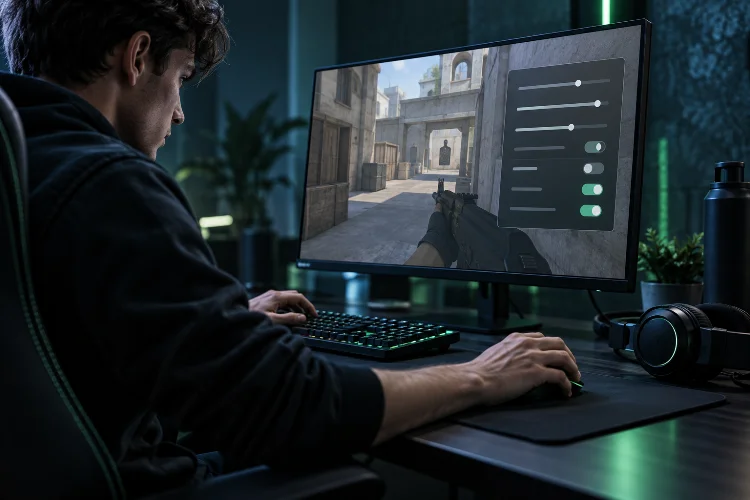
Counter-Strike 2 can look simple from the outside: buy a weapon, hold an angle, click heads. Once you start playing seriously, though, tiny details suddenly matter.
A badly chosen sensitivity can make micro-adjustments harder, distracting visual effects can hurt visibility, and poor audio settings may cause you to miss an enemy running just a few meters away.
The Best Counter-Strike 2 Settings for Competitive Play are therefore less about making the game look beautiful and more about consistency.
You want high and stable frame rates, low latency, a clear crosshair, readable enemy models, and audio that helps you identify useful information quickly.
There is no magical configuration that instantly turns someone into a high-level player. Professional players themselves use different resolutions, sensitivities, crosshairs, and graphics options.
Current data from ProSettings covering 939 CS2 professionals shows that variation clearly, although several common patterns remain.
Here is a practical competitive setup you can use as a starting point in 2026.
Best CS2 Video Settings for Competitive Play
Competitive graphics settings should prioritize visibility, responsiveness, and stable FPS.
A strong baseline looks like this:
| Setting | Recommended Starting Point |
|---|---|
| Display Mode | Fullscreen |
| Refresh Rate | Highest Available |
| Boost Player Contrast | Enabled |
| V-Sync | Disabled* |
| Anti-Aliasing | CMAA2 or suitable MSAA |
| Global Shadow Quality | Low |
| Dynamic Shadows | All |
| Model/Texture Detail | Medium |
| Texture Filtering | Anisotropic 4x |
| Shader Detail | Low |
| Particle Detail | Low |
| Ambient Occlusion | Disabled |
| HDR | Quality |
| FidelityFX Super Resolution | Disabled |
| NVIDIA Reflex | Enabled |
ProSettings currently recommends Fullscreen, Boost Player Contrast, low Global Shadow Quality, Dynamic Shadows set to All, low particle and shader detail, and NVIDIA Reflex enabled.
Dynamic Shadows is important because setting it to All keeps competitively useful player shadows visible even when overall shadow quality is reduced.
Avoid automatically setting everything to the absolute minimum. A few settings can improve visiblity without costing enough performance to justify turning them off.
Should You Use 4:3 Stretched or 16:9?
Resolution is probably the most debated CS2 setting.
Current ProSettings data shows 1280×960 as the most common professional resolution at roughly 53%, followed by 1024×768 and 1920×1080. Many professional players therefore continue using lower 4:3 resolutions, usually stretched to fill a widescreen monitor.
A stretched 4:3 image makes player models appear wider on your screen, but it does not make their actual hitboxes larger. You also sacrifice horizontal field of view compared with 16:9.
If you are new, there is nothing wrong with starting at your monitor’s native 1920×1080 or another native resolution. Try 1280×960 stretched later and compare the two.
The important part is not copying a professional player blindly. Pick the resolution where targets remain clear and your FPS stays consistant during smokes, firefights, and utility-heavy rounds.
Best Mouse Sensitivity and DPI
Sensitivity needs to be low enough for precise head-level adjustments but high enough that turning around does not require picking up your mouse three times.
The easiest way to compare sensitivities is with eDPI:
Mouse DPI × In-Game Sensitivity = eDPI
For example, 400 DPI with 2.0 sensitivity produces 800 eDPI. So does 800 DPI with 1.0 sensitivity.
ProSettings’ 2026 database reports a median professional eDPI of approximately 830. Among its tracked players, 400 DPI remains the most common mouse setting at 66%, followed by 800 DPI at 28%.
That makes something around 800 eDPI a sensible starting point, not a mandatory target.
Try it for several sessions before changing anything. Constantly moving from 600 to 1,200 eDPI and back again makes building reliable muscle memory much harder.
For mouse polling rate, 1,000Hz remains a perfectly reasonable baseline. Higher-capability mice can run at 2,000Hz or 4,000Hz, although extremely high polling rates can demand more system resources.
Best Crosshair Settings for CS2
Your crosshair needs to be visible without covering the target.
A good competitive starting point is a Classic Static crosshair with a bright color such as green or cyan, a small gap, and relatively short lines. Static designs avoid unnecessary movement and make crosshair placement easier to judge.
Professional setups show how personal this setting can be. Players commonly use different combinations of size, gap, thickness, outline, and color, even when their other settings are similar.
BLAST’s published professional configurations likewise show small static crosshairs appearing frequently among competitive players.
Do not choose a crosshair simply because your favorite pro uses it.
Load into multiple maps and test it against bright walls, dark corners, smoke edges, and player models. If you regularly lose sight of the crosshair, change its color or outline rather than forcing yourself to adapt.
NVIDIA Reflex, V-Sync, and Input Latency
Input latency matters enormously in a tactical shooter where a duel can be decided almost instantly.
If you have a compatible NVIDIA GPU, NVIDIA Reflex Low Latency is worth enabling. NVIDIA explains that Reflex reduces system latency by optimizing the rendering pipeline and preventing an excessive render queue from building up.
For a typical competitive setup without variable refresh technology, V-Sync is commonly disabled because traditional V-Sync can increase latency.
There is an important exception.
Valve added specific recommendations for systems using NVIDIA G-Sync. When G-Sync is available, CS2 can recommend enabling G-Sync, V-Sync, and NVIDIA Reflex together.
Valve notes that this configuration limits the frame rate to the display refresh rate or slightly below it while targeting smooth presentation and low latency.
So there is no single answer for everyone. Use V-Sync Off as the normal competitive baseline, but follow the G-Sync-specific configuration if your monitor and GPU support that setup.
Best FPS and Refresh Rate Settings
Higher FPS is useful, but stable performance matters more than chasing one impressive number while staring at an empty wall.
First, make sure Windows and CS2 are actually running your monitor at its maximum refresh rate. Valve has even added a warning when the game detects that a display is operating below its supported maximum refresh rate.
A 144Hz monitor is already a meaningful improvement over 60Hz, while 240Hz and 360Hz displays are widely used in serious competitive environments. ProSettings notes that high-refresh displays have become standard among professional players.
Do not destroy image clarity simply to produce an unnecessarily huge FPS counter.
Instead, test performance during heavy situations – multiple smokes, Molotovs, players, and utility effects. Your goal is smooth frametimes and enough headroom to avoid major drops during actual fights.
CS2’s Advanced Video menu also contains frame-pacing controls for maximum in-game and menu FPS. Valve added these directly to the settings interface, making FPS limits easier to configure without relying entirely on console commands.
Best CS2 Audio Settings
Great aim means less when you cannot hear where the enemy is coming from.
For competitive matches, keep gameplay audio clear and remove unnecessary distractions. ProSettings recommends prioritizing game sounds, using a suitable EQ such as Crisp or Natural depending on comfort, and reducing music that could mask footsteps or utility sounds.
Round Start, Round Action, MVP, Death Camera, and similar music volumes can generally be reduced heavily or switched off.
You should also avoid third-party virtual surround processing unless you have a specific reason to use it. CS2 already handles positional audio, and extra processing can sometimes make directional information feel less predictable.
Voice communication still matters, of course. Keep teammates loud enough to understand callouts without letting one particularly enthusiastic teammate completely overpower footsteps.
Audio should feel informative, not exhausting.
Radar, Keybinds, and Other Competitive Settings
A good radar gives you information that teammates may forget to communicate.
Zoom the radar far enough out that you can understand what is happening across most of the map. Enemy positions spotted by teammates, teammate deaths, and bomb information can all influence your next decision.
Utility should also be easy to reach.
Instead of cycling through grenades repeatedly, consider individual binds for your smoke, flashbang, HE grenade, and Molotov or incendiary. Saving even a small amount of time when throwing utility can matter during fast executes.
CS2 no longer requires the complicated jump-throw binds that became famous in CS:GO. Modern grenade mechanics make properly timed jump throws reliable without the old-style scripts.
Finally, keep network information visible when troubleshooting. If something suddenly feels wrong, knowing whether you have packet loss or connection instability is much more useful than randomly changing your sensitivity.
Don’t Copy Pro Settings Without Testing Them
Professional settings are useful because they provide proven starting points, but they are not universal answers.
One professional player may use 1280×960 stretched with extremely low sensitivity, while another uses 1920×1080 and moves the mouse much faster. Their choices reflect years of habits, hardware, roles, and personal comfort.
Change one major setting at a time.
If you switch resolution, sensitivity, crosshair, viewmodel, and audio on the same day, you will have no idea which change actually helped.
Use Deathmatch or practice maps to evaluate each adjustment seperately. Give sensitivity changes several sessions before making another big adjustment.
The goal is not to have settings that look professional on paper. It is to build a setup that feels predictable every time you enter a competitive match.
The Best Counter-Strike 2 Settings for Competitive Play focus on three things: clarity, responsiveness, and consistency.
Start with Fullscreen mode, your highest refresh rate, Boost Player Contrast, useful dynamic shadows, reduced visual effects, and NVIDIA Reflex when supported.
For aiming, an eDPI around the professional median can provide a sensible baseline, while your crosshair should remain small, static, and easy to see. Keep game audio clean, configure your radar for useful map awareness, and bind utility where you can reach it quickly.
Most importantly, stop changing settings every time you lose a match. Build a solid configuration, practice with it regularly, and adjust only when you can identify a real problem.
Better settings help, but reliable mechanics and smarter decisions are what turn those settings into better results.