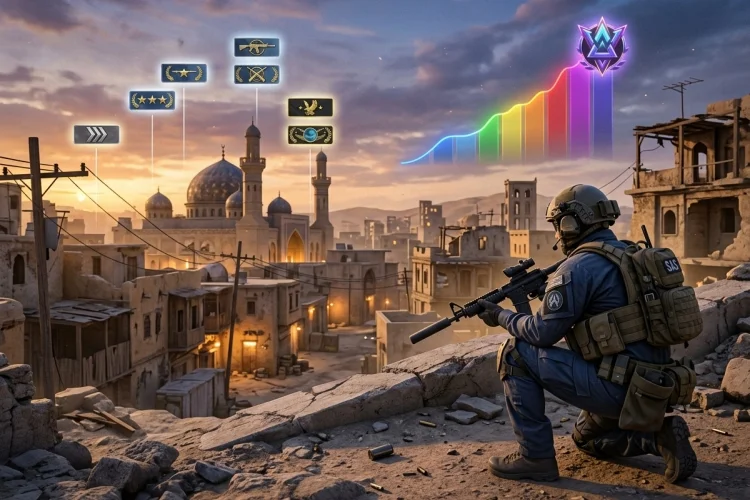
Counter-Strike 2 gives players more than one way to measure their competitive progress. You can have a traditional rank on Mirage, a completely different rank on Inferno, and a numerical Premier Rating displayed separately on your profile.
That can be confusing, especially for players returning from CS:GO, where Competitive matchmaking mainly revolved around one familiar rank. In CS2, Competitive Skill Groups are assigned by map, while Premier uses a visible number called CS Rating.
Both systems measure skill, but they serve different purposes. Competitive lets you choose the maps you want to play and develop a separate rank on each one. Premier uses a pick-and-ban phase, the Active Duty map pool, seasonal leaderboards, and one overall rating.
This guide explains Counter-Strike 2 ranks and Premier Rating, including placement matches, rating colors, Prime requirements, rank expiration, and practical ways to climb without becoming obsessed with every lost point.
Competitive Ranks vs. Premier Rating
The easiest way to understand CS2 matchmaking is to separate Competitive and Premier into two different ladders.
Competitive Mode uses classic Skill Group names such as Silver, Gold Nova, Master Guardian, and Global Elite. Your rank is calculated separately for each map, so being highly ranked on Dust II does not automatically give you the same Skill Group on Ancient or Cache.
Valve describes these Skill Groups as predictions of how well a player should perform against other players.
Premier Mode replaces named ranks with a visible numerical CS Rating. Premier also includes a map pick-and-ban process and uses maps from the current Active Duty pool. Your rating determines your position on regional and global leaderboards.
In simple terms, Competitive measures your ability on individual maps, while Premier gives you one broader rating across its rotating competitive map pool.
All Counter-Strike 2 Competitive Ranks
CS2 Competitive contains 18 traditional Skill Groups. They are arranged from Silver I at the bottom to Global Elite at the top.
| Level | Competitive Skill Group |
|---|---|
| 1 | Silver I |
| 2 | Silver II |
| 3 | Silver III |
| 4 | Silver IV |
| 5 | Silver Elite |
| 6 | Silver Elite Master |
| 7 | Gold Nova I |
| 8 | Gold Nova II |
| 9 | Gold Nova III |
| 10 | Gold Nova Master |
| 11 | Master Guardian I |
| 12 | Master Guardian II |
| 13 | Master Guardian Elite |
| 14 | Distinguished Master Guardian |
| 15 | Legendary Eagle |
| 16 | Legendary Eagle Master |
| 17 | Supreme Master First Class |
| 18 | Global Elite |
These ranks are not shared across the entire Competitive map pool. You might be Gold Nova Master on Mirage because you know its utility and rotations, but Silver Elite on a map you rarely play.
That system rewards map knowledge. Learning callouts, grenade lineups, common angles, and rotation timings on one map can improve your rank there without requiring you to master every location in the game.
How Per-Map Competitive Ranking Works
To receive a Competitive Skill Group, you must earn the required qualifying wins on the map you want ranked. After calibration, your Skill Group can increase or decrease based on future match results.
Valve does not publish the exact formula used for every promotion or demotion. Your individual statistics may reflect how well you played, but you should not assume that collecting kills guarantees an immediate rank increase.
Winning rounds and matches remains the safest priority. A player who protects the bomb, trades teammates, uses utility, and communicates useful information may contribute more than someone chasing low-impact eliminations.
In January 2026, Valve adjusted the underlying values used for per-map Competitive ranks and temporarily expired existing Skill Groups. Players had to obtain the required wins again before those ranks became visible.
What Is CS Rating in Premier Mode?
CS Rating is a visible number representing your performance in Premier matchmaking. Unlike Competitive ranks, it is not attached to one particular map.
After completing Premier qualification, the game assigns your initial rating. From that point, wins normally add rating points and losses remove them.
The interface shows how much rating is at stake, giving you a clearer picture of possible progress before the result is recorded.
Premier Rating is commonly divided into visual color bands:
| CS Rating | Color Band |
|---|---|
| 0-4,999 | Gray |
| 5,000-9,999 | Light Blue |
| 10,000-14,999 | Blue |
| 15,000-19,999 | Purple |
| 20,000-24,999 | Pink |
| 25,000-29,999 | Red |
| 30,000+ | Gold |
These colors make the leaderboard easier to read, but they are not named ranks such as Gold Nova or Legendary Eagle. Valve has not provided an official conversion chart between Premier Rating and Competitive Skill Groups.
That means a claim such as “15,000 CS Rating always equals Legendary Eagle” should be treated as an estimate rather than a fixed rule. Player distributions change between regions and seasons.
How Premier Placement Matches Work
New Premier players must complete qualification before their CS Rating becomes visible. The system uses their match history during that process to determine a suitable starting position.
Winning ten Premier matches has traditionally been required to reveal the initial rating. Losses and ties can extend the total number of games needed because the requirement is based on wins rather than simply completing ten matches.
Do not panic after one terrible placement game. The purpose of calibration is to gather enough information to position you near players with similar results.
Your first visible rating is also not permanent. Continued wins can push it upward, while repeated losses will move it down. The system is designed to adjust as it receives more information about your current level.
How Premier Rating Gains and Losses Work
The exact CS2 matchmaking formula is not publicly documented. However, Premier shows the potential rating gain or loss associated with a match, so you can see what is at stake before the game finishes.
Your recent results and the strength of the lobby can affect the amount offered. Winning streaks may produce more favorable gains, while a series of losses can make the next defeat more expensive.
This is why two players with similar ratings may not always receive identical changes. The matchmaking system may be trying to move them in different directions based on their recent records.
Avoid judging your progress through a single match. Compare your rating across 10-20 games instead. One painful loss matters far less than a long-term pattern of solid results.
Premier Seasons and Leaderboards
Premier is divided into seasons. As of July 23, 2026, CS2 is in Premier Season Four, which began with changes to the Active Duty map pool and other matchmaking updates.
Seasonal systems give Valve an opportunity to adjust maps, recalibrate ratings, and recognize players for their performance. For Season Four medal eligibility, Valve requires an account in good standing, at least 25 Premier match wins, and an active CS Rating when the season ends.
Prime players who reach the top 1,000 in their region can appear on the public Premier leaderboard. The game also offers global, regional, and friends-based comparisons.
A high rating is impressive, but regional position provides additional context. A number that seems ordinary on one server may represent a much higher percentile somewhere else.
Do You Need Prime Status for Ranks?
You can download and play Counter-Strike 2 for free, but ranked progression requires Prime Status.
Prime players can earn Competitive Skill Groups, receive CS Ratings, collect XP, access weekly care packages, and enter Premier. Valve currently requires both Prime Status and Profile Level 10 before Premier becomes available.
Prime users are also matched with other Prime users in Valve matchmaking. Players without Prime cannot appear on official Premier leaderboards.
Remember that Profile Rank is different from Competitive rank and CS Rating. Profile Rank increases through match XP and reaches a maximum of Level 40. It mainly reflects XP progression rather than competitive skill.
Why Did Your Rank or Rating Disappear?
A Competitive Skill Group can become hidden after a period of inactivity. Returning players normally need to complete the required match activity before the game displays it again.
Ranks may also be adjusted when Valve changes matchmaking values or removes wins connected to permanently banned cheaters. This does not necessarily mean that your account has been punished.
Premier Ratings can also require reactivation following seasonal changes or inactivity. Your underlying history is still relevant, so returning usually does not mean starting as a completely new player.
Treat an expired rank as recalibration rather than a disaster. Play normally, avoid forcing risky decisions to “recover faster,” and let the system gather current results.
How to Rank Up Faster in CS2
The most reliable climbing strategy is improving decisions that repeatedly win rounds. Good crosshair placement matters, but utility, communication, economy management, and trading are just as important.
In Competitive, focus on a small map pool. Learning two or three maps deeply is usually more effective than queueing every available location with limited knowledge.
Premier requires broader preparation because the pick-and-ban process can force you away from your favorite map. Learn basic callouts, smoke grenades, and defensive positions across the entire Active Duty pool.
Avoid playing long sessions while frustrated. Tilt leads to rushed pushes, unnecessary arguments, poor economy decisions, and careless peeks.
Finally, review lost rounds instead of only checking your kill count. Ask whether you used your utility, traded a teammate, protected the objective, and communicated what you saw. Those habits create consistent wins – and consistent wins are what move both Skill Groups and CS Rating upward.
Counter-Strike 2 has two main ranked systems. Competitive Mode uses traditional Skill Groups from Silver I to Global Elite, with a separate rank for every map.
Premier Mode uses one numerical CS Rating, a map pick-and-ban system, seasonal progression, and global and regional leaderboards. Neither system can be perfectly translated into the other.
A strong Competitive player may still need time to adapt to Premier’s larger map pool, while a high-rated Premier player may have different per-map ranks.
Choose the mode that matches your goals, learn a manageable map pool, and measure progress across many games instead of one result. Queue with a clear plan, communicate calmly, and focus on round-winning decisions before worrying about your next rank color.