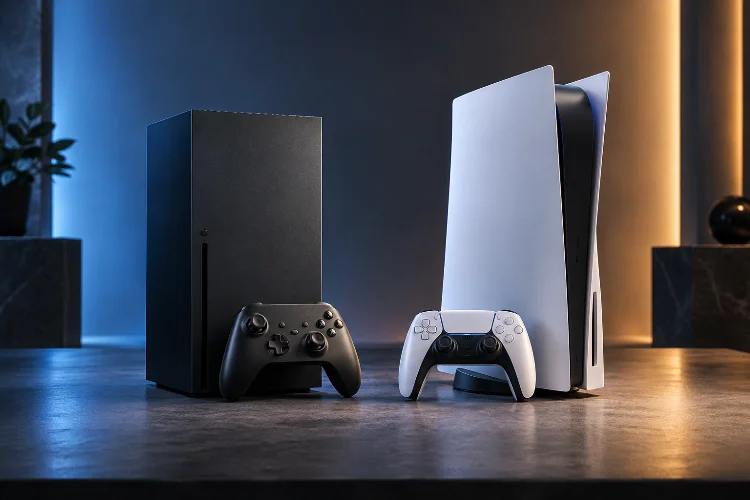
Choosing between PlayStation 5 and Xbox Series X used to feel simple: look at the exclusives, compare the specifications, and pick a side.
In 2026, that decision is more complicated. Both consoles have matured, subscription services have changed, and Microsoft has pushed Xbox games onto more platforms while Sony continues expanding the PS5 ecosystem.
The good news is that both machines are excellent. They support 4K gaming, high frame rates up to 120 FPS in compatible titles, fast SSD storage, ray tracing, modern multiplayer, and enormous libraries of current and older games.
So, PS5 vs Xbox Series X: Which Console Is Better? The answer depends heavily on what you value. PS5 has a distinctive controller and a strong PlayStation Studios catalog.
Xbox Series X offers excellent backward compatibility, Game Pass, Quick Resume, and tight integration with PC and cloud gaming.
Let’s break down the differences that actually matter.
PS5 vs Xbox Series X Specs and Performance
On paper, Xbox Series X remains the more powerful standard console in terms of raw GPU compute.
Microsoft lists its custom RDNA 2 GPU at 12 teraflops, alongside a custom Zen 2 CPU and 16GB of GDDR6 memory. It targets true 4K gaming and supports up to 120 FPS in compatible titles.
PS5 also supports 4K output, ray tracing, HDR, and gameplay at up to 120 FPS with a compatible 120Hz display. The current slim PS5 model includes a 1TB SSD.
In real games, however, the raw specification difference is rarely dramatic enough to choose a console by itself. Developers optimize titles differently, and many multiplatform releases offer similar Quality and Performance modes on both systems.
The practical advice is simple: do not buy an Xbox solely because the teraflop number is higher. Both consoles are powerfull enough to provide excellent modern gaming experiences.
Games: Which Console Has the Better Library?
This is where the comparison becomes more interesting.
PS5 has access to a strong collection of PlayStation-published games, including Astro Bot, Ghost of Yōtei, Marvel’s Spider-Man 2, Gran Turismo 7, God of War Ragnarök, and other titles from PlayStation Studios.
Sony’s current PS5 pages continue to feature many of these as major parts of the platform’s library.
Xbox has franchises and studios behind games such as Halo, Forza, Gears, Starfield, Avowed, Indiana Jones, Doom, and numerous Bethesda titles.
The difference is that “exclusive” now means less than it used to. Microsoft has increasingly expanded Xbox games across other devices and competing platforms.
Even PlayStation’s own 2025 gift guide promoted Forza Horizon 5 for PS5, illustrating how much the traditional platform boundaries have changed.
That makes PS5 attractive if PlayStation Studios games are a priority, while Xbox increasingly sells an ecosystem rather than a box containing games available nowhere else.
DualSense vs Xbox Wireless Controller
The DualSense is one of PS5’s clearest advantages.
Sony’s controller includes haptic feedback and adaptive triggers. Supported games can change trigger resistance or create more detailed vibration effects to represent actions such as firing weapons, driving across different surfaces, or pulling a bowstring.
The Xbox Wireless Controller takes a more traditional approach. Its layout will feel extremely familiar to anyone who used an Xbox One controller, and that consistency is part of its appeal.
Xbox also has excellent compatibility with existing accessories. Microsoft states that Xbox One gaming accessories work with Xbox Series X|S, reducing the need to replace everything when upgrading.
For immersion, DualSense has the more ambitious feature set. For simplicity, battery flexibility, and a familiar layout, some players may still prefere the Xbox design.
Controller comfort is personal, so neither shape is universally better.
Game Pass vs PlayStation Plus
Subscription services could easily decide this comparison.
Xbox Game Pass Ultimate currently provides access to more than 500 games across Xbox consoles, PC, and supported devices.
It also includes online console multiplayer, cloud gaming, EA Play, Ubisoft+ Classics, in-game benefits, and major day-one releases. Microsoft reduced the US price of Ultimate to $22.99 per month in April 2026.
There is an important exception: Microsoft announced that future Call of Duty titles will no longer arrive on Game Pass at launch and are instead planned to join later.
PlayStation Plus uses three tiers.
Essential provides monthly games and online multiplayer. Extra adds a catalog containing hundreds of games, while Premium also provides classics, game trials, and cloud streaming. Current US annual prices are $79.99 for Essential, $134.99 for Extra, and $159.99 for Premium.
Game Pass is particularly appealing if you constantly try new games. PS Plus becomes more attractive if you already prefer the PlayStation ecosystem and want access to its rotating catalog.
Backward Compatibility: Xbox Has the Broader Reach
If you own a large library of old console games, Xbox Series X has a significant advantage.
Microsoft supports compatible titles across four Xbox generations. Most Xbox One games work on Series X|S, while selected Xbox 360 and original Xbox games are also playable. Some receive benefits such as Auto HDR, higher resolution, or FPS Boost.
PS5 backward compatibility is focused primarily on PlayStation 4.
Sony says more than 4,000 PS4 games can be played on PS5, with Game Boost improving frame rates or performance in selected titles.
That is still an enormous library, but it does not offer the same direct multigenerational reach as Xbox.
PlayStation Plus Premium provides a Classics Catalog for older PlayStation titles, but that is a subscription-based library rather than universal backward compatibility with every old disc you may own.
Retro-minded players will generally find Xbox more convienient.
Storage and Expansion
Modern games are enormous, so storage matters more than it sounds.
Current PS5 slim models include 1TB of internal SSD storage. PS5 also supports compatible M.2 SSD expansion, giving players a relatively broad market of drives from different manufacturers that meet Sony’s specifications.
PS5 games can also be stored on compatible external USB drives, although they must be transferred back to internal or M.2 SSD storage before being played. PS4 games can run directly from supported external USB storage.
Xbox Series X also comes in 1TB configurations, with a 2TB Galaxy Black version available as another option.
For high-speed expandable storage, Series X|S uses dedicated Storage Expansion Cards that connect through the expansion port and match the internal SSD experience.
Xbox’s solution is extremely easy to install—essentially plug and play.
PS5’s M.2 approach requires a little more effort but gives buyers more choice when shopping for additional storage.
Xbox Is Better Connected to PC and Other Devices
One of Xbox’s strongest features in 2026 is that the ecosystem extends well beyond Series X.
Xbox Play Anywhere allows compatible games to be purchased once and played across Xbox consoles, Windows PCs, and supported gaming handhelds without another game purchase. Saves, achievements, and supported add-ons travel with the player’s account.
Microsoft reported in April 2026 that more than 1,500 games supported Xbox Play Anywhere.
Game Pass Ultimate further extends that idea through PC access and cloud streaming.
That makes Xbox especially appealing to someone who owns a gaming PC or handheld and does not want every game locked to one device.
Sony has also brought many PlayStation titles to PC and offers Remote Play, but its console-PC integration is not as tightly unified around buy-once cross-device ownership.
For someone who switches regularly between console and PC, Xbox is the more flexibile ecosystem.
Quick Resume vs PS5’s Fast SSD Experience
Both consoles are fast, but they approach convenience differently.
PS5’s high-speed SSD enables rapid loading and is deeply integrated into the system’s design. Moving between areas in properly optimized games can feel almost instant compared with older console generations.
Xbox Series X adds Quick Resume, which can suspend supported games and let you return to them later without starting from scratch. Microsoft lists Quick Resume as one of the shared next-generation features of Series X|S.
It sounds like a small feature until you regularly jump between three games.
If you frequently switch between a single-player RPG, a racing game, and something multiplayer, Quick Resume can become one of those conveniences you miss when it is gone.
PS5 is hardly slow, but Xbox deserves credit for making game switching especially seamless.
Which Console Offers Better Value in 2026?
Value depends on how you buy and play games.
Xbox Series X makes a compelling argument for players who want a subscription-first approach.
Game Pass can provide hundreds of games without requiring individual purchases, while backward compatibility and Play Anywhere increase the usefulness of existing Xbox and PC libraries.
PS5 makes more sense when specific PlayStation games are the main attraction. The DualSense features also add something that cannot be represented clearly in a specification table.
Both offer disc and digital hardware options, though available configurations and pricing vary by country and retailer.
Before purchasing either system, make a short list of five games you genuinely want to play. Then check which platform gives you the easiest and cheapest way to access those titles.
That usually tells you more than arguing about hardware numbers.
PS5 vs Xbox Series X: Which One Should You Buy?
Choose PS5 if you primarily want PlayStation Studios games, value DualSense haptics and adaptive triggers, or already have a large PS4 collection.
Choose Xbox Series X if Game Pass, backward compatibility, Quick Resume, and cross-device gaming with Windows PC are more important.
If you already own a capable gaming PC, the decision becomes particularly interesting. Microsoft’s Play Anywhere strategy means much of the Xbox ecosystem overlaps heavily with PC, making PS5 a potentially more complementary second device.
On the other hand, someone already invested heavily in Xbox purchases and Game Pass may appreciate having everything synced across devices.
Your existing library and friends list should also influence the decision. Hardware differences matter less when everyone you regularly play with is already on one ecosystem.
So, PS5 vs Xbox Series X: Which Console Is Better? There is no universal answer, but the strengths are now very clear.
PS5 stands out for its DualSense controller, PlayStation Studios catalog, strong PS4 compatibility, and polished console-focused experience.
Xbox Series X excels at Game Pass, multigenerational backward compatibility, Quick Resume, and a flexible ecosystem extending across console, PC, handhelds, and cloud gaming.
For players starting completely fresh, PS5 is particularly appealing when exclusive-style console experiences matter most. Xbox Series X becomes extremely compelling when access, subscriptions, and cross-device flexibility are the priority.
Before buying, compare your must-play games, existing library, subscription costs, and where your friends play. The better console is ultimately the one you will actually use more.